01 · The question
One sentence
Reprocessing the same 2004 XMM data with 2024+ calibration, does the soft X-ray emission ~7 kpc off the disk of NGC 6810 (interpreted by Strickland 2007 as a starburst superwind) still exist, and are the temperature and abundance still the original values?
This is a historical positive control: the same data, the same set of region geometry, with calibration and screening software as the only change. It measures no new physics, but the reproducibility of the moderately inclined starburst-galaxy XMM literature after nearly two decades of software evolution.
02 · Why it matters
Whose published conclusion would change
Directly constrained is Strickland (2007, MNRAS 376, 523): A new superwind galaxy: XMM-Newton observations of NGC 6810. That paper, using SAS 6.5-era processing, reported soft X-ray emission extending ~7 kpc above the disk plane, spatially correlated with off-disk Hα (including a ~5 kpc NW filament), interpreted as a starburst-driven superwind. NGC 6810 is one of the few moderately inclined (b/a≈0.28) superwind cases, sitting between the edge-on (NGC 253, M82) and face-on (M83, NGC 6946) extremes, and is cited repeatedly in the superwind literature (Strickland, Heckman, Mitsuishi, Lopez, and others).
Both directions change the credibility of a published conclusion: SUPPORT makes Strickland (2007) a calibration-robust benchmark for moderately inclined superwinds, and turns "can ~25 ks of PN clean XMM data detect 5–7 kpc off-disk hot gas at 29 Mpc" into a capability benchmark with an answer; WEAKEN means the historical result depends on SAS 6.5-era calibration or screening, the analogous moderately inclined superwind literature needs re-examination, and it motivates re-observing NGC 6810 with deeper XMM or XRISM.
Scope boundary: one reprocessing of one galaxy cannot "validate" any population-level superwind prescription; it constrains one published result for this target, this epoch, this sensitivity.
03 · Sky geometry and archive coverage
The data already exist: one core-pointed EPIC observation
NGC 6810 (RA=295.89341°, Dec=−58.65561°, SIMBAD; D=29.24 Mpc) has only one XMM science observation within a 0.5° cone: ObsID 0205220101 (2004-04-25, MEDIUM Full Frame, aimpoint 0.007′ from the nucleus), scheduled PN 46.835 ks / MOS1 48.454 ks / MOS2 48.477 ks; the historical Strickland (2007) clean time was PN 25.5 ks, MOS 44.1 ks each. Chandra, Suzaku, NuSTAR, NICER, eROSITA all return zero records within the 0.5° cone (XSA/HEASARC cone queries, hashes archived in the target card).
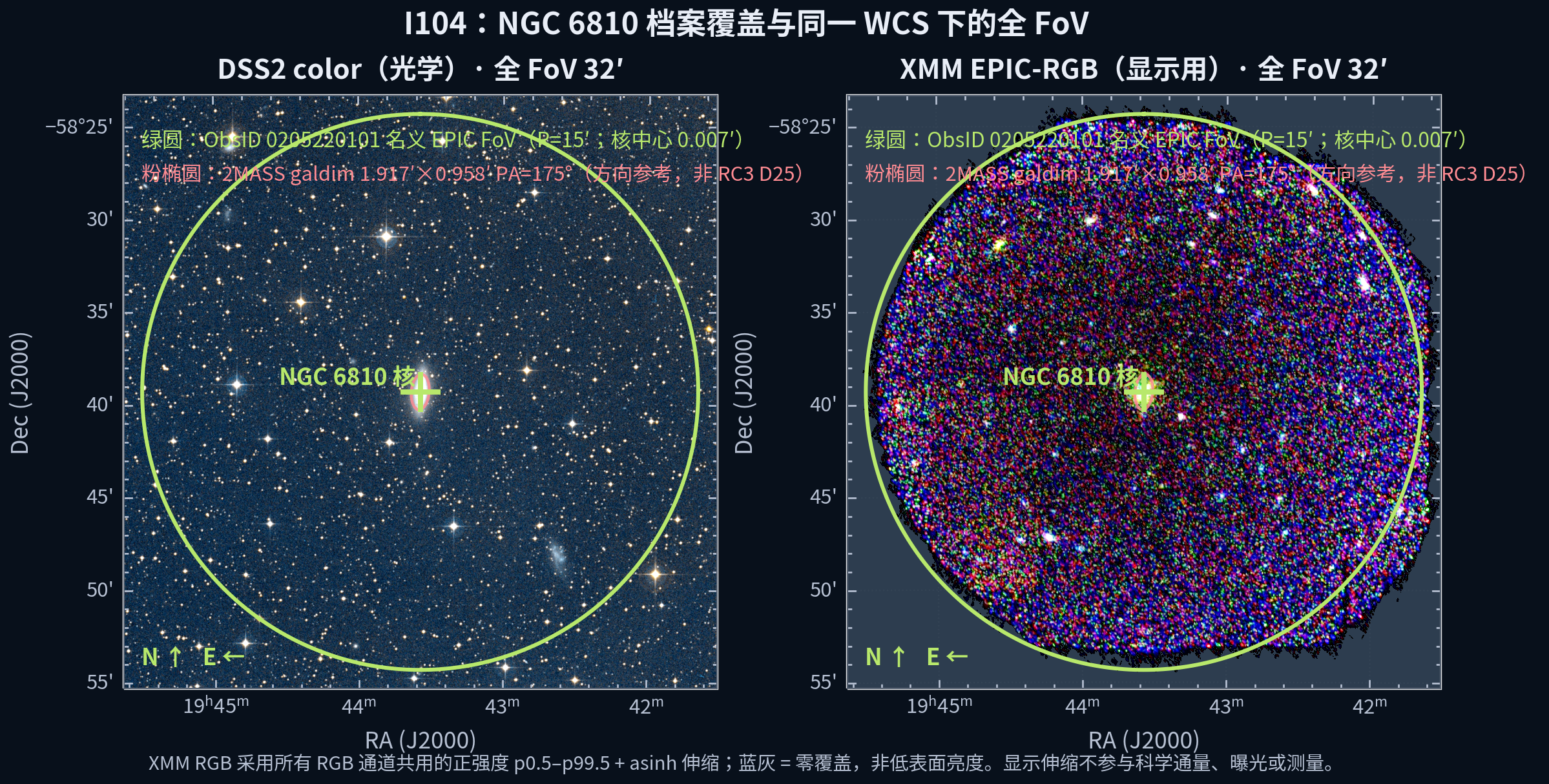
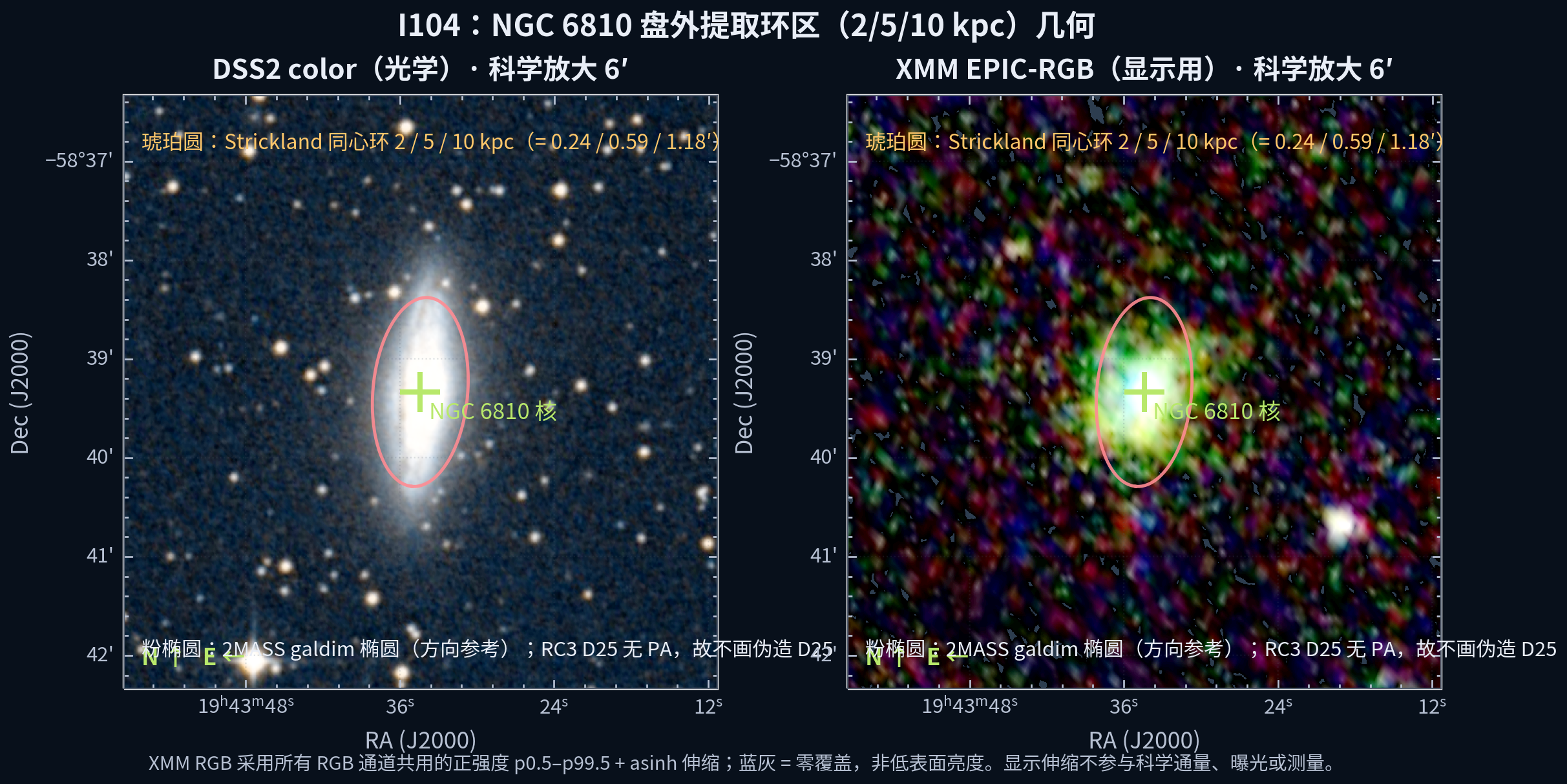
The XMM RGB uses a positive-intensity p0.5–p99.5 percentile clip shared by all channels with an asinh stretch; blue-gray means zero coverage, not low surface brightness. This display stretch participates in no exposure correction, science flux, or any measurement; the overlay lines use raw WCS.
04 · The number actually being measured
Temperature, abundance, and surface-brightness profiles under the same geometry
Extract PN+MOS joint spectra in source-masked off-disk concentric annuli (r = 0–2, 2–5, 5–10 kpc, following the Strickland 2007 geometry) and fit APEC + power-law:
- SUPPORT: off-disk emission is detected at ≥3σ at r ≥ 5 kpc, with kT ∈ 0.2–0.8 keV, Z ∈ 0.1–1.0 Z☉, and the surface-brightness profile agrees with Strickland (2007) within the EPIC cross-calibration uncertainty between cameras.
- WEAKEN: off-disk emission is detected but kT falls outside 0.2–0.8 keV at 3σ, or the profile exceeds cross-calibration uncertainty, or the abundance pattern is inconsistent with starburst-wind enrichment (e.g. Z > 1.0 Z☉ pointing to AGN enrichment).
- INCONCLUSIVE (recovery failure only): the reprocessed data do not reach the 3σ detection threshold at r ≥ 5 kpc — this is a recovery target failure, not a physical interpretation.
Known defects in the criteria (recorded in R4, not hidden on this page): the WEAKEN temperature window borrows the T55 cross-calibration uncertainty, but T55's applicable range is kT 2–10 keV, while here kT≈0.5 keV is in the sub-keV regime, so that threshold needs recalibration (R4 REFRAME R01); and Strickland (2007)'s 2T+PL fit has kT2=1.03 keV, which already falls 0.23 keV outside the 0.2–0.8 keV window, so the criterion must specify which component it acts on (R4 CORRECTION C01). These are why G1 is not closed, and why this page does not claim "criteria are frozen."
05 · If the answer comes back the other way
WEAKEN carries information; INCONCLUSIVE is honest boredom
If after reprocessing the off-disk emission disappears, or the temperature/abundance significantly deviates: this means the SAS 6.5-era moderately inclined superwind measurement is sensitive to calibration and screening, and Strickland (2007)'s interpretation needs a confidence downgrade — itself a publishable negative result, and a direct motivation for one deeper re-observation. If the data simply cannot reach the recovery threshold (e.g. PN clean time after current GTI screening falls far below 25.5 ks), that is INCONCLUSIVE: a boring null; this page will not disguise it with figures, and it is not worth spending more HEAVY on it.
06 · Costs and still-unknown costs
Zero new observation time; the cost is one scope-limited HEAVY reprocessing
Observation cost is zero (archive track). Compute cost is one SAS ≥20 + ESAS ≥3 reprocessing: ODF download (~several GB), event processing, mos_filter/pn_filter GTI screening, source-mask construction (2MASS+SDSS), annular-region spectrum extraction, ARF/RMF, APEC fitting. Still-unknown cost elements: (a) whether the clean time after current GTI screening is still close to 25.5 ks PN / 44.1 ks MOS (I104-E1, OPEN) — if it drops below ~15 ks, the 3σ target at r≥5 kpc may be unreachable; (b) response-folded recovery and APEC recovery simulations have not been run (I104-E3/E5, OPEN); (c) the source mask must be rebuilt from the current event lists (I104-E4, OPEN).
Executable options for the PI
Approve: authorize the HEAVY reprocessing package above (E1 GTI audit → E4 source mask → E3/E5 recovery → extraction and fitting). No new observation is promised.
Do not approve: stop here; this page has already stated that the entire value of this idea is a reproducibility benchmark.
Sources and reproducibility
Evidence boundaries of this page
- Strickland (2007), A new superwind galaxy: XMM-Newton observations of NGC 6810, MNRAS 376, 523. arXiv
- Locally traceable inputs: I104 idea card, cycle-obs9 R3 evidence (I104-E2 CLOSED, bounded ADS with no current-calibration reprocessing), R4 critique (REFRAME R01 / CORRECTION C01), NGC6810 target card (XSA/HEASARC cone queries, hashes archived).
All numbers on this page come from the files above; the figures are HiPS2FITS real-WCS display products (display-only), with scripts and hashes recorded in this shift's publication manifest.